There are many types of breathwork in existence. The style that I work with is Conscious Connected Breathwork. This style is known for working with the emotions in the body, often called “therapy without talking”. But how can something as simple as breathing have such profoundly healing results? The researchers are interested in finding out too…
I recently found a study which looks into what is going on inside the brain and body that allows this breathwork to make changes in emotions held for years in the body [“Neurobiological substrates of altered states of consciousness induced by high ventilation breathwork accompanied by music,” published by Kartar et al. (Colasanti Lab, Brighton & Sussex Medical School) in PLOS ONE (August 2025)” link].
It is fascinating stuff, but rather dense. So here is my attempt at an explanation of what they found.
What did they do?
This was a study on High Ventilation Breathwork (HVB *). This type of breathing was done by the participants for a period of time, gradually increasing their breathing rate. This connected breath style changes the mix of oxygen and CO2 in the blood.
There were 27 participants and the results I focused on are the in-person lab results.
* HVB in this case seems to be a generic term for the same breath style used in Conscious Connected Breathwork (CCB). In the study they included music, but no guidance, affirmations or touch so the effectiveness of the breathwork would have been lessened compared with CCB.
What did they measure?
The researchers measured blood flow in different parts of the brain, the flow rate and oxygen usage. This allows them to see which parts of the brain were active and which were passive during the different phases of the breathwork (resting, starting breathwork, fully active breathwork).
They also measured a number of subjective experiences, from the standard 5D-ASC measures of experience. I’ll highlight two here.
– Oceanic Boundlessness (this increased). This is a shorthand for “spiritual experience, insightfulness, blissful state, positively experienced depersonalization, and the experience of unity”.
The most interesting feature of Oceanic Boundlessness is that it is “reportedly the most accurate predictor of antidepressent actions of psychedelic substances”.
It is quite amazing to me that simply by changing how we breathe can take us into a state otherwise typically requiring psychedelics.
– Dread of Ego Dissolution (this stayed flat). This is measuring the concern of losing control, the anxiety around what is going on. This is your prefrontal cortex fighting to stay in charge of the situation. In my experience of talking to people, this fear of “having a bad trip” or being “out of control” seems to be a major concern with psychedelic experiences.
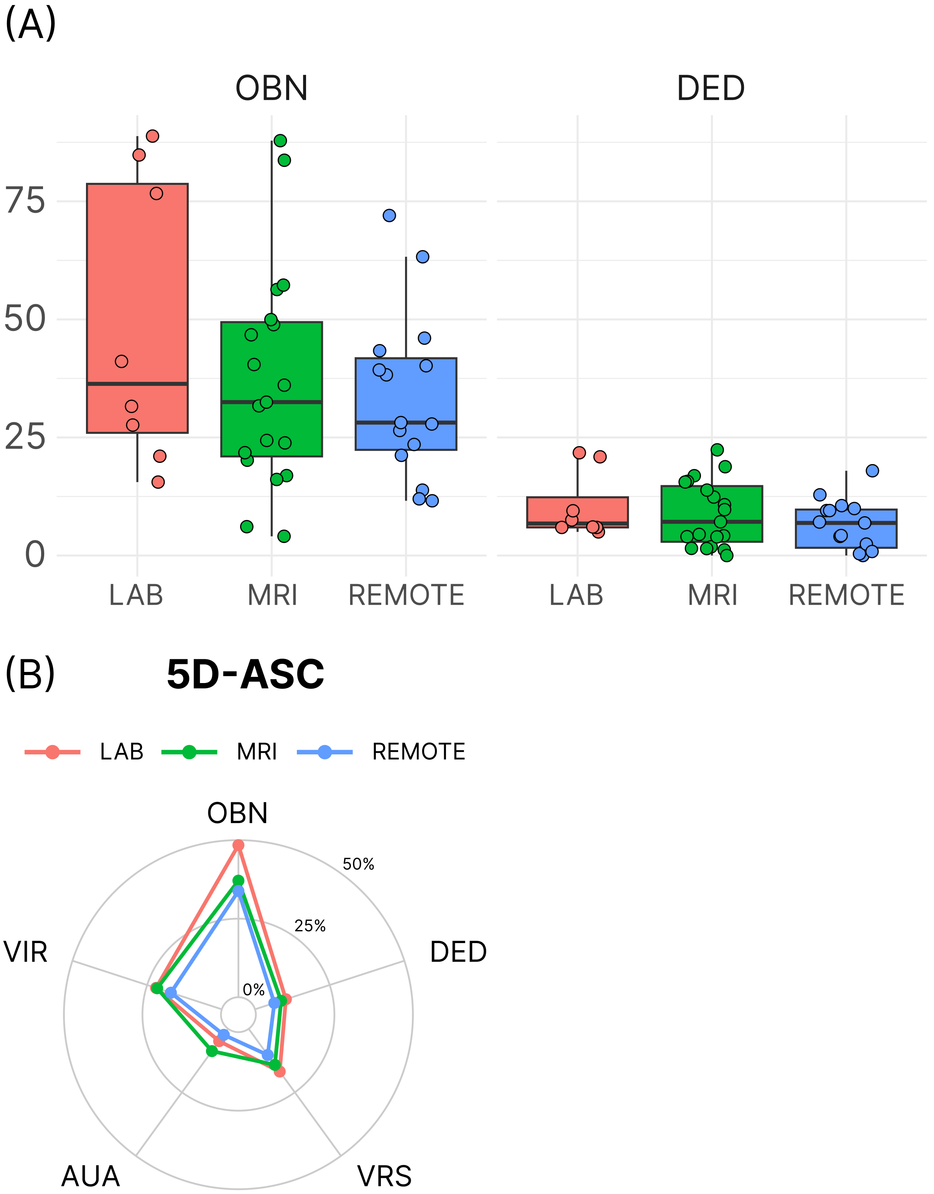
You can see that in all settings the DED stays low.
The other reassuring thing about using connected breathwork to shift your mental state is that you can always just stop, breathe normally, and your physiological state reverts to normal within a couple of minutes at most, but the integration and healing from the session stays with you.
What happens in the brain when we do CCB?
When you breathe in a circular* fashion what happens is probably not what you expect.
* Circular means no pauses after inhale or exhale. If you have a cat or a dog, watch them breathe when they are resting. This continuous circular pattern is how most animals breathe, but not how humans normally breathe.
When doing CCB you are exhaling CO2 faster than your body can produce it. There is a whole other discussion around the role of CO2, but for now we will focus on the fact that CO2 is used in the brain as a vasodilator – it keeps blood vessels wide – so a reduction of CO2 in the system means reducedblood flow to the brain (7 – 19% reduction in Cerebral Blood Flow in general).
At this point the body starts to prioritize which bits of the brain to keep fully online and which can slow down and take a back seat.
The body always chooses safety over everything else. This is always a fundamental aim of our nervous system (even when it doesn’t feel like it to us).
This figure from the study shows two areas of the brain lit up, while the rest of the brain becomes deactivated.
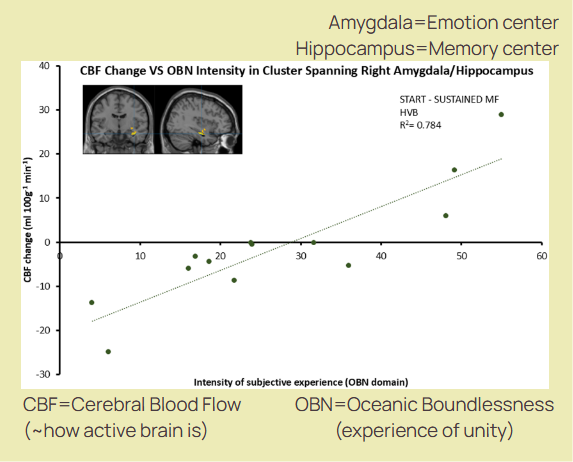
With an R2 value of 0.784 the study shows a correlation of ~80%, where the experience of Oceanic Boundlessness is directly explained by the changes in blood flow.
Zooming in shows amygdala and hippocampus active while the rest of the brain is passive:
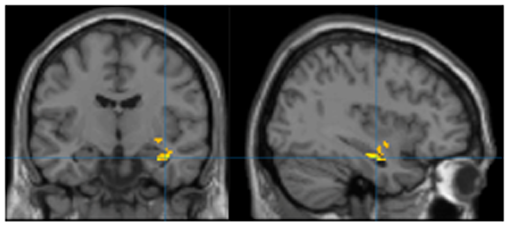
The body is prioritizing threat detection
- the emotional alarm system (the Amygdala).
- the memory indexing system (the Hippocampus), to ensure the emotional alarm system can recognise threats from our history.
and deprioritizes ego, control, planning and tracking
- the gatekeeper (the Prefrontal Cortex), which is always trying to keep everything “safe” and under control, it’s like the supervisor or manager.
- the here-and-now tracker (the Posterior Insula), which is tracking your body sensations, how your body currently feels and where it is in the world.
In a way, the brain moves from “standard mode” into “critical task mode”.
Note that while the rest of the brain is quiet, the amygdala and hippocampus are running hotter than normal, they are not just business-as-usual.
While the physical changes in the brain can be seen quickly when circular breathing starts, the emotional and thought-process experiences change in the breather slowly and gradually through the session.
What experience does this result in?
As the emotional alarm system and deep memory processing is given priority, the control and “ego” is given less.
Now we move into interpretation of what could be happening based off the brain activity scans and my knowledge and experience of CCB.
With the ego dialed back, the gatekeeper is not as active in interpreting, supressing and controlling feelings. We are not as worried about appearing to be in control all the time so we can allow feelings to express.
With the here-and-now monitoring system turned right down, the normal stream of information about the body is still arriving, but our interpretation and filtering of that information is radically reduced. We stop labelling or even suppressing sensations from our body in our familiar way. This raw data can then be felt by the rest of the brain in full and without interference.
Our memory system and emotional alarm system gradually get to run the show unencumbered by the gatekeeper.
When working with in-person Conscious Connected Breathwork, the stimuli coming in are:
- raw physical feelings from the body while breathing, possibly from old injuries or simply felt tension
- touch, intensifying the physical feelings from the body, activating known acupressure points in the body where tension is often stored
- music, often strongly linked to emotions and memories
- affirmations, often triggering more memories or limiting beliefs
When these stimuli bring up emotions, the ego gatekeeper is no longer actively trying to suppress some feelings, or come up with explanations and stories around them to explain them away, dampen them or stop them. The stored charge is released (homeostatic reset), the open loop can be closed.
The brain and body get to feel the unfiltered sensations of the emotion and allow the feeling to run to completion.
When the active part of the breathwork ends and breathing returns to normal, the ego gatekeeper and here-and-now monitor come back online and integrate the newfound felt experience of the body, now without the charge/tension that has just been released. As part of the integration the gatekeeper can drop any story it was running to suppress the old feeling since the story is no longer required.
Why don’t other animals need breathwork?
Why are the wild animals that live in semi-permanent danger not requiring breathwork sessions to remove their stress?
Dr. Peter Levine, creator of Somatic Experiencing (SE) is one of the leading experts in trauma with over 50 years of experience in the subject. He often describes how trauma stays in the body until it can be “shaken off”.
Here (YouTube link) Dr. Levine says
“… that energy … gets shaken off. And then we restore to our nervous system balance. Again, it’s innate, but people, humans, have fought against that, and then it just accumulates.”
Here you can see a polar bear being chased, sedated, then shaking off the stress of the experience (link)
There are other examples where “caught” impalas or zebras manage to jump up from playing dead, run to escape, and then after escaping find a safe place to lay down and shake uncontrollably for a few minutes. This shaking dissipates the survival energy that remained in the body from the massive hormone dump, allowing any excess energy to be released from the system. Then they get up and carry on their life, appearing to be stress free despite walking so close to death.
Note, the zebra does control this urge to shake for long enough to escape the situation. It too can suppress the shaking response when it needs to but the zebra doesn’t suppress it for longer than required.
Why do humans fight against this natural physical method to release stress and why are they so good at it?
My intuition is that it is due to our strong social conditioning and the relatively large size of our prefrontal cortex. Throughout early life we learn that we must look and be “normal” to fit in and be safe in the group, and shaking uncontrollably just doesn’t fit into that very well, at least not previously. In my cultural upbringing there was a definite underlying message that I needed to Keep Calm and Carry On, just like the coffee mugs say. For me this story became very powerful, I was self monitoring constantly. Even in private this internal messaging was active for me (and probably many others), restricting my ability to ever truly let go. The relatively large prefrontal cortex (ego gatekeeper) means we can exert control over the rest of the system for a long time (possibly years), keeping us out of balance, which often comes at a price. For me the price was a reduction of my emotional range in order to keep me functional, making my world into shades of grey and leading to functional depression.
Using breathwork to turn down this egoic gatekeeper part of the brain in a suitably safe environment, the body and nervous system can then do what it has wanted to since the original time of stress without judgment. This doesn’t always have to result in shaking or movement, but the bodies wisdom can now do what is required to complete the stuck cycle.
Finally the stored stress energy can be expressed and released.
How it feels after a breathe
I find that the experience of this process is different each time I breathe, and many others report the same. The key thing I feel is that after a breathe something has lifted.I feel like a weight has been removed from my life.
Possibly a fully repressed feeling has been felt for the first time in years, possibly since early childhood. Felt and released.
Sometimes the release can be gradual and take multiple sessions to work through, sometimes great change can happen in a single session.
Each time I breathe, I feel a bit better than before.
Wrapping up
Ongoing research is bringing new understanding to how Conscious Connected Breathwork is such a powerful healing tool.
I found this research paper very interesting. I am one of those people that like to know how things work, although not knowing doesn’t stop me using methods that bring me good results. I’m a pragmatist at heart.
Note that CCB also has lots of purely physical health benefits which I’ve not mentioned here.
I am interested to hear your comments. Is this news to you or does it fit into your existing mental model?
If you are interested to experience this breathwork yourself, I am offering one-to-one sessions in North London.
Possibly we can breathe together soon.
Leave a Reply